
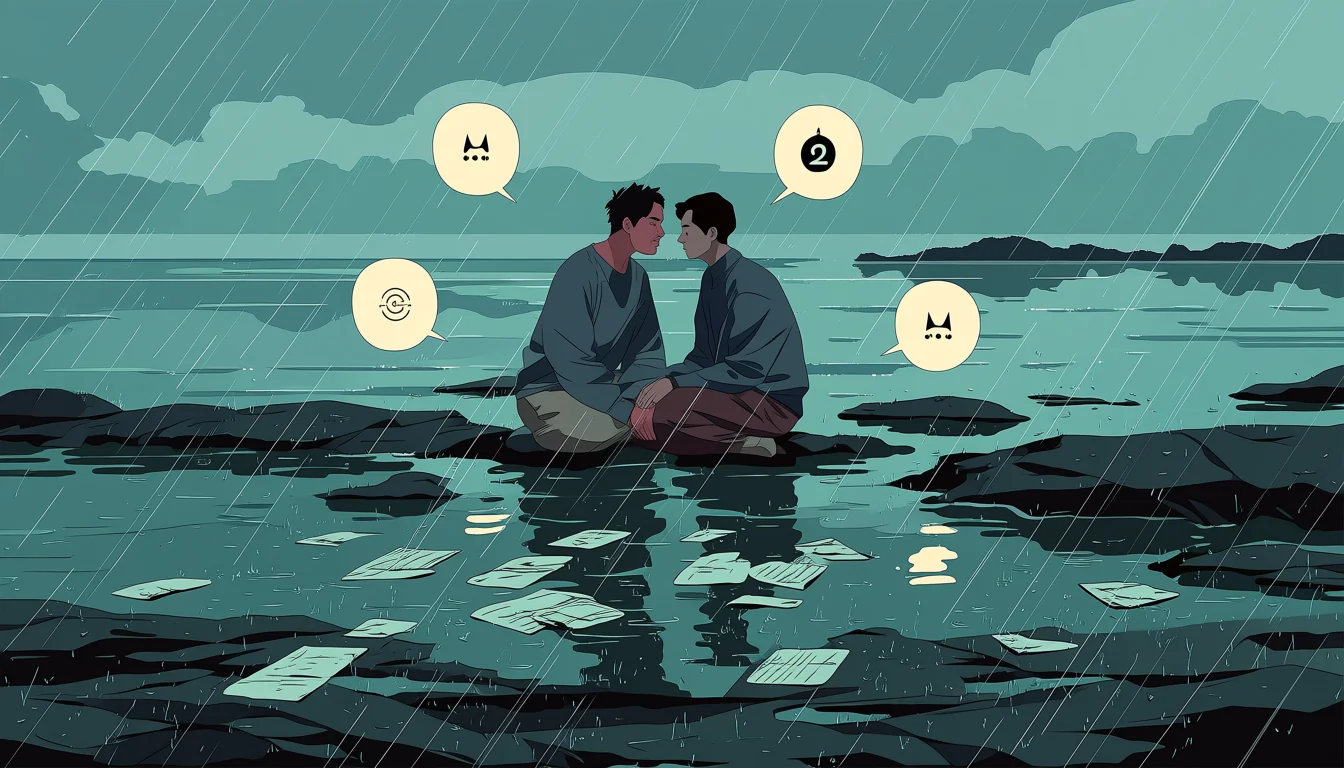
In a medium that spends most of its budget on explicit material, the kiss is usually treated as connective tissue: a couple of frames on the way to something else. That is a strange allocation, because it is one of the few beats that can show two fictional adults deciding on each other, and it is among the cheapest things in the whole production. The scenes people describe years later are full of them.
What a kiss carries that nothing else does
It is mutual by definition. Two people moving toward each other at once, which makes it the clearest possible depiction of a shared decision. Nothing else in an intimate scene communicates that as economically, because everything else can be one-sided in a way a kiss visibly cannot.
It also carries hesitation beautifully. The approach can stall, restart, or be met halfway, and each version says something different about the relationship. That range of meaning in a single gesture is rare.
And it is legible at any size, which matters when most viewing happens on a phone, as covered on the 390-pixel test.
Why productions skip past it
Partly habit: the genre's structure treats intimate scenes as a sequence of acts, and a kiss reads as a step rather than a destination. Partly economics: nobody storyboards extra seconds for something they consider preliminary. And partly because it is genuinely hard to animate well, since faces at close range expose every weakness in a drawing.
There is also an inherited assumption that romance beats belong to mainstream animation and explicit beats belong here, as though the two were separate jobs. Nothing supports that division except habit. The productions that ignore it tend to be the ones people recommend to friends.
That last reason is real but backwards. Difficulty is where the value is. A well-drawn kiss is one of the strongest arguments a production can make about its own quality, and viewers register it immediately even if they cannot say why.
Staging one properly
Give it three beats rather than one: the approach, the contact, the moment after. The approach is where consent becomes visible. The contact is short. The moment after is where character shows, because that is when the two people have to decide what they now are to each other.
Camera distance matters. Too close and it becomes anatomy; too far and it becomes a silhouette. Mid-distance with both faces readable is usually right, and cutting closer only when something specific needs to be seen.
Sound should be almost nothing. Breath, cloth, a room tone. Music over a kiss is the most common way to make a genuine moment feel like an advertisement, which is the tonal risk described on hentai video pacing.
The moment after is the scene
Two adults who have just kissed are in a new situation, and the first second of that is the most revealing thing you can show. Do they laugh, look away, hold on, apologise, say nothing. Each choice tells the audience who these people are more efficiently than any dialogue would.
It is also the cheapest second in the sequence. One held drawing of two faces very close together, neither of them moving. No new backgrounds, no complicated motion, nothing that needs a specialist. The cost-to-effect ratio is better than almost anything else a production can spend on.
Skipping it is the same error as skipping aftermath elsewhere, discussed on the quiet minute after an intimate scene. The peak is not where meaning lives.
In comics it is a panel problem
On the page the same beat is built from panel count and size. Three panels — approach, contact, after — with the largest given to whichever carries the decision. One panel for the whole thing reads as a plot event; three read as a moment.
The gutter does the timing here, which is the mechanism described on intimacy from panel to panel.
Giving the kiss its seconds back
Three beats, mid-distance, almost no sound, and time afterwards. Four decisions, all cheap, and they turn a transition into the part of the scene people describe when they recommend it to someone else.
Two fictional adults, unmistakably grown, choosing each other on screen. It is a small thing to ask for and it is missing from a remarkable amount of otherwise careful work. The connected studio route is on the night studio.