
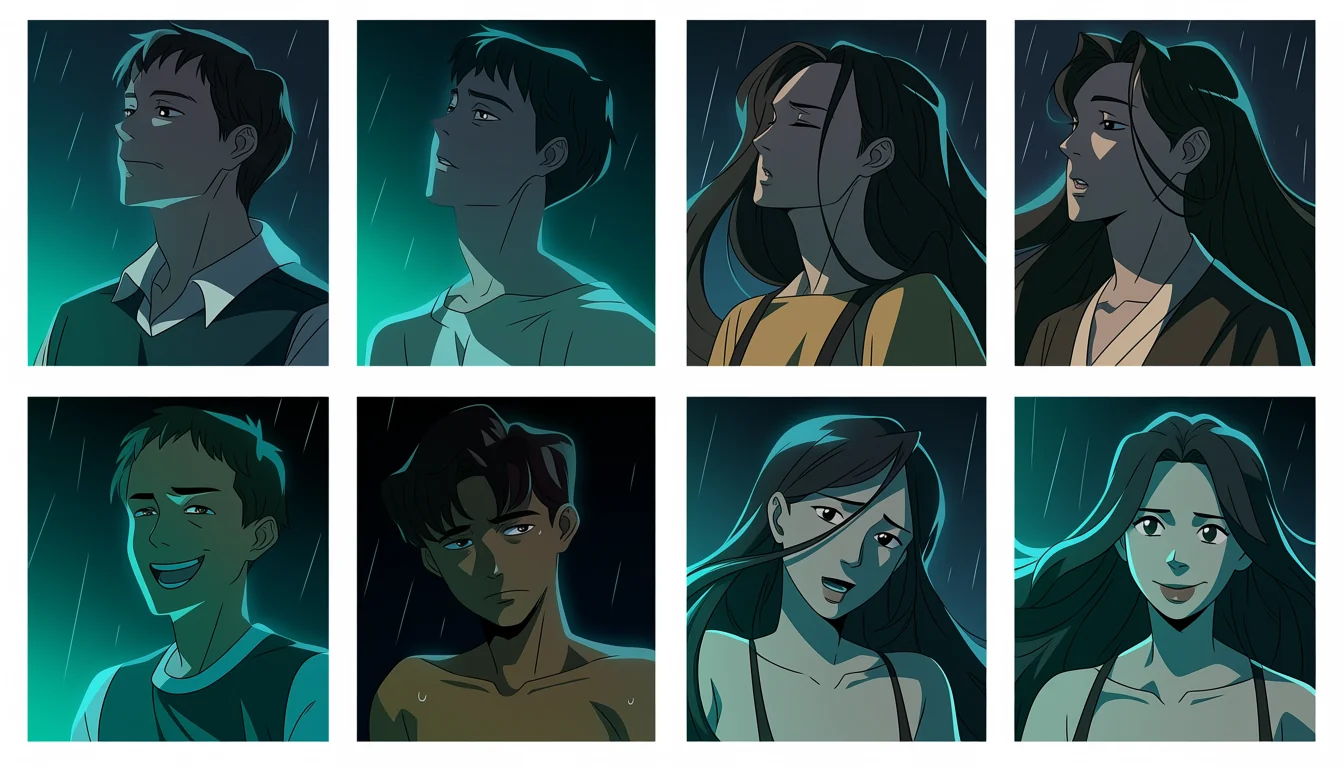
Look at a hundred intimate scenes in adult animation and a pattern appears: the good ones happen somewhere. Not against a soft gradient, not in a room that exists only as a bed, but in a place with weather outside it, objects in it, and a sound of its own. This is not an expensive thing to do. It is mostly a matter of deciding the location matters before anyone starts drawing.
A gradient is not a place
The default shortcut is to blur everything behind the figures. It saves time, keeps attention on the characters, and produces a scene that could be happening anywhere, which is the problem. Anywhere means nowhere, and nowhere means the audience has nothing to hold on to besides the bodies.
A place gives the scene a memory hook. Readers describe scenes by their setting far more often than by their choreography: the one on the balcony, the one during the storm, the one in the empty office at night. That is what a location buys, and a gradient cannot buy it at any price.
It does not need detail. Three objects and a light source is enough to establish a specific room, and three objects is a trivial amount of drawing compared with what the figures already cost.
Sound, temperature, and clutter
Three cheap tools make a room present. Sound: rain, a fan, traffic, a fridge, silence with a distant something in it. Temperature: whether these fictional adults are warm, cold, damp, sticky. Clutter: the objects that were already there before anyone came in, and which nobody tidied.
Clutter in particular is underused. A room with a half-unpacked bag and a mug on the floor belongs to somebody. A room with nothing in it belongs to the production. That difference lands on the audience immediately even though nobody consciously notices the mug.
In animation the audio track can carry all three at once, which is why sound design is such good value in this genre. That case is made at more length in hentai video pacing.
Continuity is a form of respect
Clothing that reappears, a window that changes from night to dusk, a lamp that switches sides between panels. Readers spot these and quietly downgrade their trust in everything else. Continuity errors do not just break the illusion; they announce that nobody was checking.
Backgrounds are where this slips most often, because attention naturally goes to the figures. A room drawn once and then approximated from memory across twelve panels will drift, and the drift is always in the direction of simpler. By the last panel the specific room has quietly become a generic one.
The fix is a one-page reference: room layout, light sources, what everyone is wearing, what has been moved. Ten minutes at the start saves a great deal of correction later, and it is the same habit recommended in the night-studio routine.
Privacy is part of the atmosphere
A room with a closed door reads differently from a room with an open one. A curtain half drawn, a phone face-down, a lock turned — small details that tell the audience these two adults chose to be alone together. Without them, scenes can drift toward feeling observed rather than private.
The opposite choice can be deliberate and good. A scene that is meant to feel exposed — a risk taken somewhere not quite private — uses the same tools in reverse, and it works because the audience registers the difference. What does not work is arriving at that feeling by accident.
That sense of intrusion is what people are describing when they say a scene felt clinical. It is usually a staging problem rather than a drawing problem, and it connects directly to the framing question worked through in who a scene is drawn for.
What a scene that remembers the room gets
It gets specificity, which is the thing generic work can never buy. Two fictional adults in a particular place on a particular night doing something they chose. That is a story. The same two people against a gradient is an illustration of an act.
Three objects, one light source, a sound, and continuity notes. That is the whole recipe, and it costs almost nothing next to what has already been spent on the figures. More of the same thinking is in the mood-first end of the genre.