
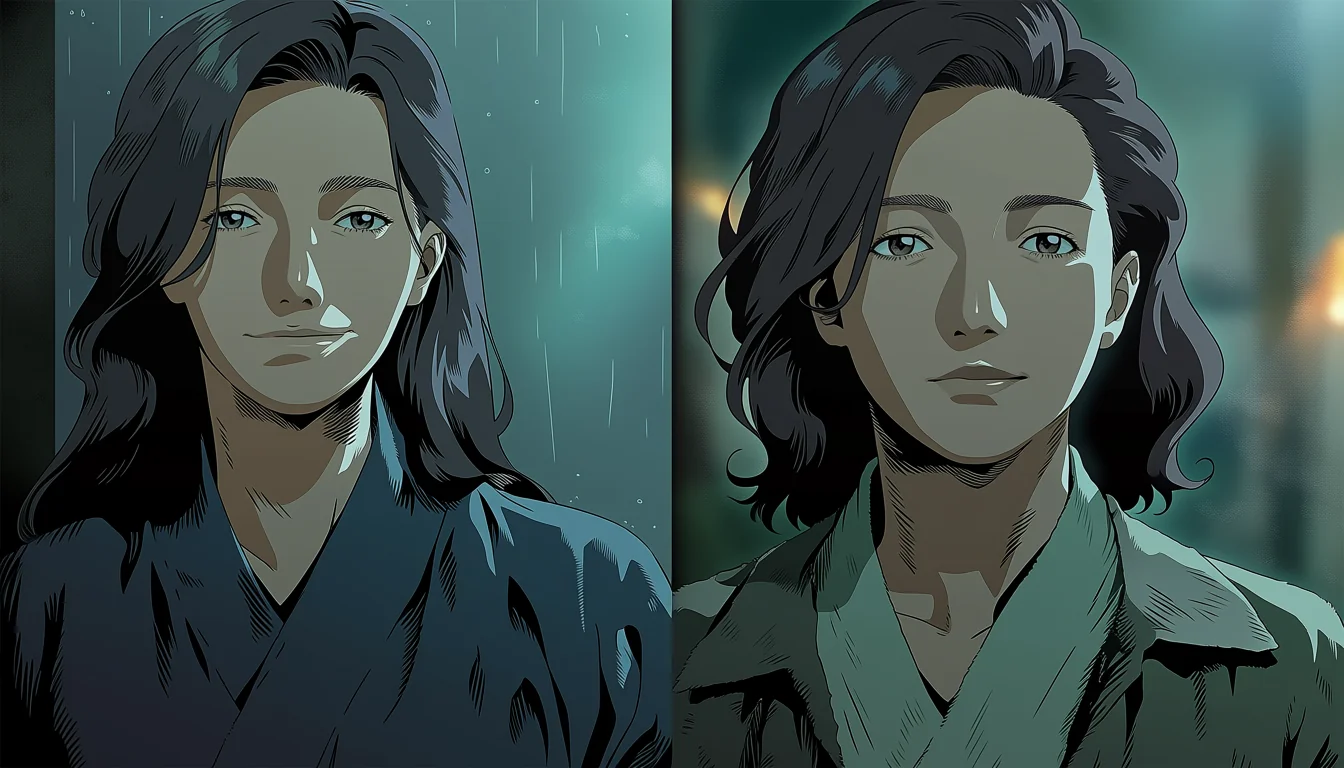
Two fictional adult women in an intimate scene can be drawn two completely different ways with the same character designs. In one, the camera is a participant: it sits where a person in the room would sit, follows what the characters are attending to, and treats their attention to each other as the subject. In the other, it is a spectator: positioned for display, faces turned outward, the pair arranged rather than involved. The difference is not subtle once you have seen it named.
The camera decides the audience
Camera position is the most honest thing in any scene. Put it at the height and distance a person present would occupy and the viewer is inside the moment. Put it low, wide, and centred for maximum display and the viewer is outside it looking in. Neither is forbidden, but they produce different work and attract different audiences.
Spectator framing dominates the tag for commercial reasons. It photographs well as a thumbnail, and thumbnails drive clicks. The cost is that the scene stops being about the two people in it, which is why so much of the category feels interchangeable even with good drawing.
The grid economics behind that are described in what a thumbnail is optimised for, and they explain more of this genre's visual habits than any artistic preference does.
Eye lines are the tell
Follow where each character is looking. In a participant-framed scene they mostly look at each other, occasionally away, rarely at the viewer. In a spectator-framed one both faces angle outward toward a camera neither character can see. That single detail changes whether you are watching a relationship or a display.
It is also the cheapest fix available to an artist. Turning one head so the characters are attending to each other costs nothing and transforms the reading of the whole image. Very few improvements have that ratio.
Hands are the second tell. Hands that respond to the other person read as involved; hands arranged decoratively read as posed. Both are drawn in the same amount of time.
Pacing tells you the same thing
Scenes written from inside spend time on approach — the decision, the first contact, the check that this is wanted — and they stay afterwards. Scenes written for display skip both, because neither photographs well. If a piece opens mid-act and cuts at the peak, you already know which kind it is.
Duration is a useful proxy when you are choosing. A piece that runs long relative to how much plot its description promises is usually spending that time on the parts a display-led piece would cut. It is not a perfect signal, but it beats guessing from a still image.
Approach and aftermath are also where character shows. Two adults who have been together for years behave differently in those minutes than two who have just started, and depicting that difference is most of what makes a scene feel specific rather than generic. The full argument is in the quiet minute after an intimate scene.
Why this matters beyond taste
This is not an argument that display framing is immoral. It is an argument that it is one option that has been treated as the only option, and that the tag is far larger and more interesting than its most-clicked version. Readers who find the category repetitive are usually describing the spectator half of it.
It is worth saying who tends to make the difference. Work drawn by people who are themselves interested in these characters as people, rather than as a category to fill, ends up framed from inside almost by default. Intent shows in staging long before it shows in a description.
There is more work drawn from inside than the front page of any site suggests. Finding it means ignoring thumbnails and looking at descriptions, running lengths, and creators rather than tags, which is the browsing method set out in watching free the slow way.
What a scene drawn from inside looks like
Camera at human height. Eye lines between the characters. Hands responding rather than posing. Time spent before and after. Two fictional adults who are unmistakably grown and clearly choosing this. Five things, all free, and together they produce a scene that stays with a reader.
That is the kind of work this haven writes about and the standard it holds itself to, as described on why this haven stays quiet. Creation with proper account and safety controls stays on the connected studio rather than being copied here.