
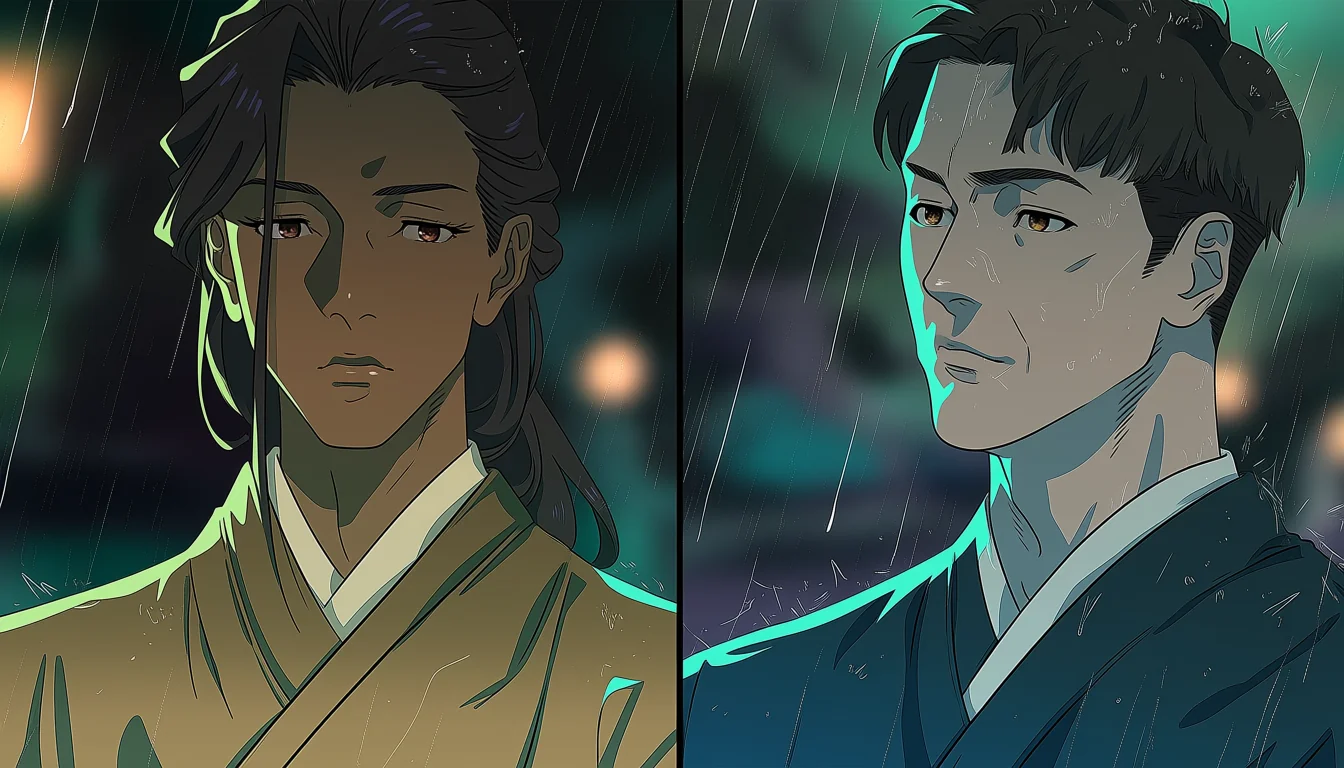
Dubbing gets treated as a downgrade by people who have never listened closely to a good one. It is not a subtitle read aloud. Every line has to fit a mouth that was already animated, in a language with different rhythm and word order, while carrying the same feeling. That is a second creative act, and in intimate scenes — where half the audio is breath rather than words — it is a much harder one than most people assume.
Matching a mouth that already moved
The animation is finished before the dub starts. Mouth movements have a fixed length and shape, so the script has to be rewritten to fit them rather than translated literally. A line meaning I have missed you might become a shorter or longer phrase entirely, chosen for syllable count as much as sense.
This is why comparing a dub to a subtitle word for word is unfair to both. The subtitle is trying to be accurate. The dub is trying to be speakable at a specific length with a specific mouth shape. Judge each on whether the scene works, not on whether the sentences match.
Adult animation makes this harder because so many lines are short, breathy, or half-finished. Those are the hardest things to time and the easiest to get slightly wrong in a way the ear notices immediately.
Breath is the performance
In an intimate scene the actual words are a small part of the track. What carries it is breathing, hesitation, a swallowed start, the sound of somebody deciding whether to speak. None of that is in the script. It is invented in the booth by a performer watching the picture, and it is where a careful dub separates itself completely.
A rushed session produces breath that sounds applied rather than felt: even, rhythmic, disconnected from what the character is doing. A good one produces breath that changes with the moment and occasionally stops when it should. Listen for the stops. They are the hardest thing to fake and the clearest sign somebody cared.
This is the same territory the picture is working in, described from the drawing side in hentai video pacing. Sound and image are trying to do the same job with different tools.
Small casts and thin margins
These productions use two or three voices. There is nowhere to hide a weak performance behind an ensemble, and no budget for many takes. One actor who has not settled into the character can flatten an entire release, which is why casting matters more here than on a show with twenty speaking parts.
Direction matters just as much. A performer given context — who this person is, what they want, what changed in the last scene — delivers something a performer handed a line list cannot. The absence of that direction is audible, usually as a delivery that is technically correct and emotionally blank.
Dub or subtitles: a real choice
Subtitles preserve the original timing and performance, and you read instead of watch. That trade is costly in a medium built on looking at things. Missing a held expression because your eyes were at the bottom of the screen is a genuine loss, especially in slow atmospheric work where the expression was the beat.
A dub returns your eyes to the picture. If the performance is good, that is a clear win; if it is bad, you have swapped one distraction for a worse one. Neither answer is universally right, which is why decent releases offer both and let you switch. More on how the English side of that developed sits in the English dub page.
Listening to a dub properly
Give it a full scene before judging. First lines in any dub are the worst, because the performer is still finding the character and the mixer is still finding the level. By the second scene you can hear whether the breath is real, whether the silences are placed, and whether the voice belongs to the body on screen.
Then apply the ordinary standard. Fictional adults, unmistakably grown, and a credited production where the people who did the work are named. Voice actors are frequently left off adult releases entirely, which is its own small injustice. The house view on crediting is in why this haven stays quiet.