
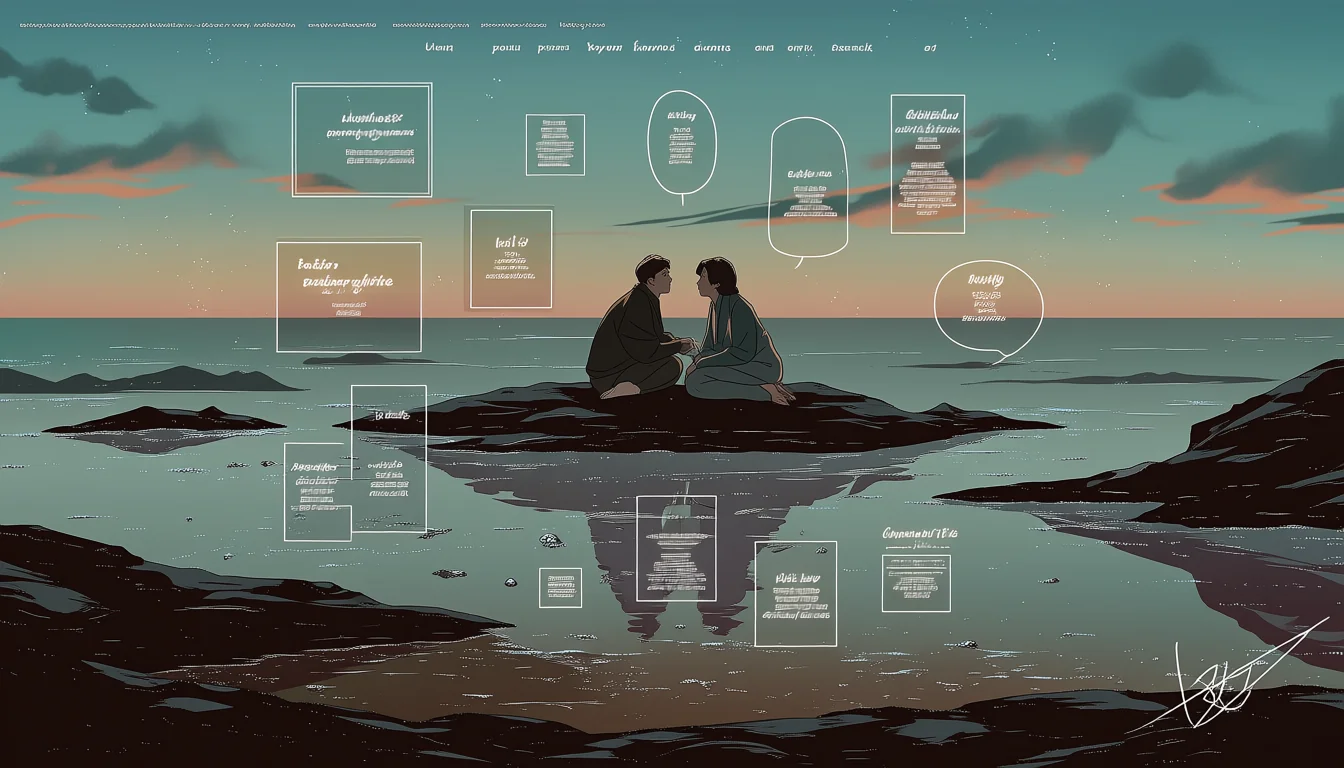
There is a single beat that separates intimate scenes people remember from scenes that pass without trace. It is the moment before contact: two fictional adults close enough to touch, neither one moving yet, both aware of what is about to happen. Nothing occurs in it. It costs one drawing and a second of runtime. It is also the first thing to be cut whenever a production runs short, which is why so much of this material feels procedural.
What that second contains
Three things at once, which is unusual for any single frame. Agreement, because both people are choosing to stay. Nerves, because the outcome is not yet certain. Desire, because nobody stands that close by accident. A held frame lets the audience read all three, and reading all three is what makes the scene feel like it involves people.
Remove it and you get action without a decision. The characters go from apart to together with no visible moment of choosing, which reads as the plot moving rather than as two adults doing something. The difference is small on a storyboard and enormous on screen.
It also does the consent work without a word of dialogue, which is the most elegant version of it available. Nobody has to announce anything; the audience simply watches two people decide.
How cheap it is to keep
One held drawing, a slow push in or nothing at all, and a sound: breath, rain, a clock, the room. That is the entire cost. Compared with animating any part of what follows it is close to free, which makes cutting it a strange economy.
The reason it gets cut anyway is that it looks like nothing on a schedule. A line item reading two seconds, no movement is the easiest thing in the world to delete when a deadline slips. Nobody deletes an action sequence, because the loss would be obvious.
Protecting it is a matter of naming it in the storyboard as a beat rather than as a gap. The same defence applies to aftermath, discussed in the quiet minute after an intimate scene.
Staging the pause
Distance is the main control. Close enough that contact is imminent, far enough that it has not happened. Eye lines should meet, or one should be looking and the other about to. Hands matter: a hand raised and not yet landed carries more than a hand already placed.
Light helps as well. This is the moment to let a lamp or a window do something specific, because the audience has time to look. Every choice made in a held frame gets noticed, which is both the opportunity and the risk.
Sound carries the rest, and the best option is often almost nothing. A room tone with one small detail in it makes two seconds feel considerably longer than a music cue does.
Why procedural scenes feel flat
When every transition is a cut from position to position, the scene becomes a list. Lists are readable and forgettable. The viewer is never asked to anticipate anything, and anticipation is the mechanism by which any of this lands emotionally.
You can test a scene for this. Count the moments where something is about to happen and has not yet. If the answer is zero, the scene is a list regardless of how well it is drawn, and no amount of rendering will fix it. The connected craft argument is in the case for atmosphere.
Keeping the beat before the touch
Name it in the storyboard. Give it a sound. Stage it with distance and eye lines. Defend it when the schedule slips, because it is the cheapest thing on the board and it is carrying more than anything around it.
Two fictional adults, unmistakably grown, one second of not moving. That is the whole technique, and it is why some short scenes stay with people for years. More on the mood-led end of the form is on hentai core, and the connected studio route is at the night studio.