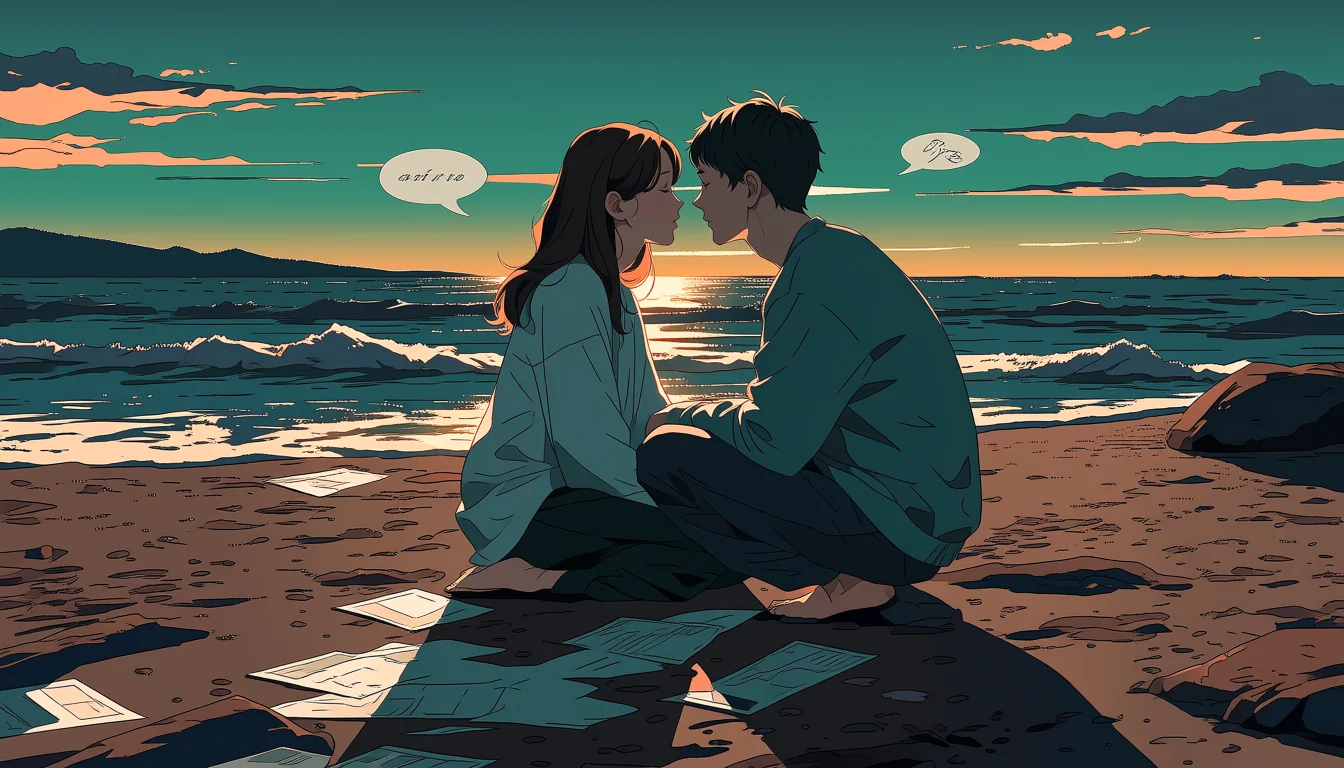
Restraint has been part of illustration for as long as illustration has existed, and drawn adult work has a long tradition of it. Done thoughtfully it is one of the most expressive things two fictional adults can be shown doing, because it makes trust visible. Done carelessly it slides into imagery that is about power taken rather than power given, which is a different subject wearing the same rope.
The scene that happens first
In practice, people who do this talk beforehand. What is allowed, what is not, what word stops everything. Fiction skips it constantly, and the skip is precisely what makes so much of this material read badly. The conversation is not paperwork; it is the moment the trust being depicted is actually established.
Drawn or animated, it does not need to be long. One panel of agreement changes the reading of everything after it. A nod, a hand offered, a checked expression. Without that, the audience is asked to assume consent, and assumption is a weak foundation for a scene built entirely on trust.
It is also more interesting than most of what it replaces. Two adults deciding something together is drama; two adults already mid-scene with no context is a still life.
Draw the trust, not the knots
Technical accuracy in rope work is a nice touch and it is not the point. What the audience reads is faces, breathing, and the relationship between the two figures. A perfectly rendered tie on a blank expression communicates nothing. A simple restraint with an expression of complete ease communicates everything.
Composition follows from that. Keep the restrained character's face in frame. Give them a sightline to the other person. Show that they can be seen and heard. Cropping the face out is the single fastest way to turn a trust scene into an objectification scene, whatever the artist intended.
The same visual logic about eye lines and personal space runs through the quiet minute after an intimate scene, which is worth reading alongside this.
What comes after is part of the work
Untying, water, a blanket, sitting together for a while. In practice this stage matters as much as the scene itself, and in fiction it is almost always cut. Including it is unusual enough that audiences notice immediately, and it tends to be the part people mention when they describe a piece as tender.
There is a practical reason too. A scene that ends at the peak leaves the audience holding tension with nowhere to put it, which reads as abruptness rather than intensity. The wind-down is what lets the intensity register properly, in the same way a held note needs silence after it.
It also completes the story. A restraint scene without an ending is a setup with no resolution. Thirty seconds of care afterwards turns an image into an account of a relationship, which is a much better use of the same drawing time.
How bad work gives itself away
Look for three things. The face cropped or turned away throughout. No indication that either person can communicate. And framing that positions the viewer as an intruder rather than as someone the characters are aware of. Any two of those together and the piece has stopped being about trust.
Reluctance played as a plot device is the other common failure. Fiction is allowed to depict complicated feelings, but there is a difference between a character who is nervous and a character who is refusing. Work that blurs the two is not being daring; it is being sloppy about the one thing this subject cannot afford to be sloppy about.
There is a separate and absolute line: characters must be fictional adults, unmistakably grown, with no ambiguity and no real-person likeness. Restraint imagery is exactly where that line gets tested by careless work, which is why it is stated flatly rather than implied. The house rules are in the understanding of this house.
What anime bondage can do at its best
It can show two adults handing each other something difficult and being careful with it. Very few subjects let an artist depict trust that directly. That is the reason the tradition has lasted, and it is entirely unrelated to the shock value the tag usually gets sold on.
Agreement visible, face in frame, care afterwards. Three conditions, all of them free, all of them making the work better rather than safer only. The connected studio route for making this kind of image, with its own safety controls in place, is at the night studio.